Every Jacksonville Beach Condo Sits Inside the Same Compliance Line. One Building Is Built to Dodge It.
September 24, 2026
September 24, 2026
If you've been comparing condo listings in Jacksonville Beach against single-family homes on the same streets, you've probably noticed the price gap looks smaller than the age gap. A 1976 oceanfront tower and a 2024 low-rise a few blocks apart can carry HOA dues that differ by a factor of three, even when the square footage and the view are close to identical. The usual explanation is condition. The real explanation is a calendar, and it starts the same day for every condo building in this city, no matter when it was built.
Here's the mechanism nobody puts on a listing sheet: Florida's post-Surfside inspection law splits buildings into two groups based on distance from the coast. Buildings within three miles of the water hit their first mandatory structural inspection at 25 years old. Buildings farther inland get until 30. Jacksonville Beach doesn't have an inland side. The city's own building department states it plainly on its safety page: every building in Jacksonville Beach sits within three miles of the Atlantic Ocean's coastline, so every condo or co-op tower here that's three stories or taller runs on the 25-year clock, not the 30-year one.
That single geographic fact means Jacksonville Beach condo buildings age into inspection five years faster than a comparable building in, say, inland Duval County. It also means the oldest wave of buildings here, the towers that went up in the 1970s and 1980s during the first real condo boom on this stretch of A1A, all crossed their 25-year threshold decades before the 2022 law even existed. The state's rule closed that gap retroactively: any building occupied on or before July 1, 1992 had to complete its first Phase One milestone inspection before December 31, 2024. That deadline has already passed. What's happening now, in the back half of 2026, is the second act: the repairs those inspections turned up.
Two buildings on the same beach are living that second act in public right now.
Ocean 14 went up in 1976, a 17-story oceanfront tower that was already 45 years old when Surfside changed the law five years ago. Its own homeowners association is currently running what it calls the Ocean 14 restoration project, with a board meeting held in the building's clubroom on August 27, 2026, and ongoing exterior construction the association has been updating residents about all year. At least one active listing in the building reflects the cost directly: the seller is offering to credit the buyer at closing toward the coming HOA assessment, which covers planned replacement of the oceanfront windows and sliding glass doors.
A few miles north on 19th Avenue North, Pelican Point tells a similar story on a different timeline. Built in 1982, it's a 17-story, 101-unit tower that's carried a reputation as a stable, long-held building with a tennis court and a loyal owner base. A current listing there notes that milestone-related repair work to balcony ceilings is set to begin the week of October 19 or 26, 2026. Different building, different repair, same root cause: a structure old enough to have crossed the 25-year line years before the law required anyone to check.
| Building | Year Built | Height | What's Happening in 2026 |
|---|---|---|---|
| Ocean 14 | 1976 | 17-story oceanfront tower | Restoration project underway; board meeting held Aug. 27; sellers crediting buyers toward the coming window and slider assessment |
| Pelican Point | 1982 | 17-story, 101-unit oceanfront tower | Milestone-related balcony ceiling repairs scheduled to begin the week of Oct. 19 or 26 |
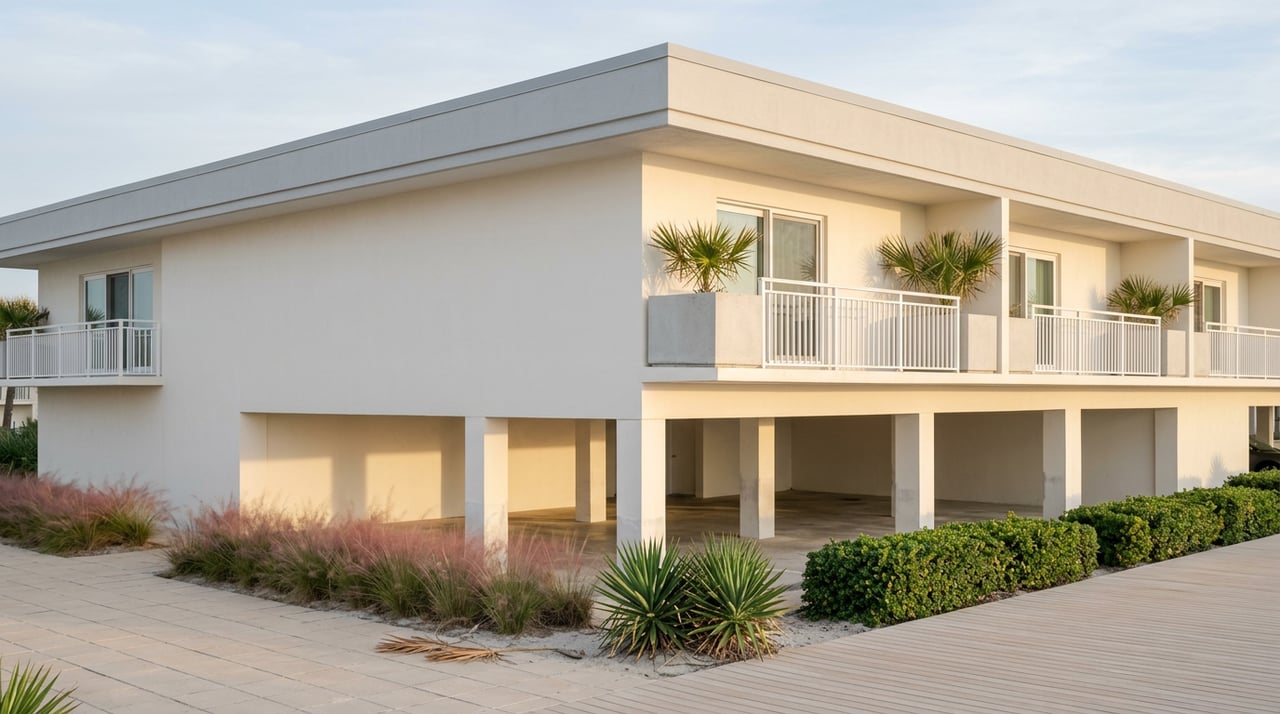
| A newer low-rise oceanfront building | Not disclosed in listing | 2 habitable stories over a parking deck | Marketed by its seller as exempt from the SIRS and milestone mandate; HOA dues holding at $500 a month with water included |
That third row in the table isn't hypothetical. One current Jacksonville Beach listing leads with its compliance status as a selling point, stating outright that the building is exempt from Florida's SIRS and milestone structural mandates because it has two habitable stories over a parking deck, which keeps it under the three-story threshold that triggers the law. The seller ties that exemption directly to the number that matters to a buyer's monthly budget: a stable $500 a month HOA fee with water included, a figure the listing frames explicitly against the assessment risk facing area high-rise towers.
That's the mechanism laid bare. The 25-year clock and the reserve mandate that came with it don't care about a building's age in the way people assume. They care about habitable story count. A three-story-plus building built in 2026 still needs a Structural Integrity Reserve Study on file, because the SIRS requirement is triggered by height, not age. A two-over-parking building can be decades away from any mandatory structural inspection simply by design. Height decides which calendar you're on. Age decides where you are on it.
Jacksonville Beach's condo market carries a wide spread for exactly this reason. As of August 2026, the median list price across active condo listings in the city runs around $560,000, while recent closed sales carry a median closer to $448,750, a gap that reflects sellers pricing ahead of where the market is actually clearing. Meanwhile the trailing 12-month median for single-family homes in Jacksonville Beach sits around $615,000 as of mid-September 2026, a figure that's climbed roughly 215 percent since 2012.
That single-family-versus-condo comparison undersells the real story, which is what's happening inside the condo number itself. At the top of the market, oceanfront towers like Pablo Beach South, The Metropolitan, Oceanside 932, Pablo Surfside, Acquilus III and The Waterford anchor a segment priced from roughly $950,000 into the multi-millions. In the city's gated condo inventory, buildings like Palms at Marsh Landing, Villas at Marsh Landing, Valencia and Pablo Beach House span from the $180s to over $3 million. Square footage explains part of that range. It doesn't explain all of it. A building's position on the inspection and reserve calendar increasingly shows up in its dues, its resale confidence, and now its financing.
That last point got more concrete this year. Fannie Mae and Freddie Mac retired their streamlined condo review options for loans dated on or after August 3, 2026, which means more Jacksonville Beach condo buildings now go through a Full Review that scrutinizes the association's budget, reserves and insurance before a loan closes. A building with a completed milestone inspection and a funded SIRS clears that review with less friction. A building still working through Phase One or sitting on a pending special assessment gives a lender, and a buyer's financing timeline, more to question.
None of this means older buildings are a bad buy or that newer ones are automatically the safer choice. Ocean 14 and Pelican Point are both mid-repair, not mid-crisis, and a building actively working through its restoration is arguably in a more transparent position than one that's quietly deferred the same work. What it does mean is that the question worth asking about any Jacksonville Beach condo isn't just how old the building is. It's where the building sits on the three-mile rule, whether its milestone inspection and SIRS are complete, and what the reserve study says about what's coming next.
Ask for the milestone inspection report and the Structural Integrity Reserve Study before you write an offer, not after. Ask whether a special assessment is pending, proposed, or already being collected. If the building is under three habitable stories, confirm that in writing rather than assuming, since that's the detail deciding whether the mandate applies at all.
A few common questions
Does a building's age tell me anything if it's under three habitable stories? Not for milestone-inspection purposes. The height threshold governs the SIRS and milestone mandate regardless of when the building was constructed, which is why a two-over-parking design can sidestep the requirement even if it's decades old.
If a tower already completed its milestone inspection, is the risk over? The inspection is a point-in-time report, not a permanent clearance. Buildings three stories and taller repeat the milestone inspection every 10 years after the initial one, and the SIRS itself is required again on the same 10-year cycle.
Does this affect single-family homes in Jacksonville Beach? No. The milestone inspection and SIRS mandate apply specifically to condominium and cooperative association buildings three habitable stories or taller under Florida law. Single-family homes and most townhome HOAs fall under separate statutes.
If you're weighing a Jacksonville Beach condo against a single-family home, or trying to read what a specific building's HOA fee and reserve status actually mean for your offer, Pamela Hoffman can walk through the documents with you before you're locked into a contract. Let's Talk About Your Move.
October 1, 2026
September 24, 2026
September 17, 2026
September 10, 2026
September 3, 2026
August 27, 2026

August 20, 2026
August 13, 2026
August 6, 2026
Pamela Hoffman is a top-performing real estate advisor and licensed broker associate who can expertly guide you through your real estate journey. With over 25 years of sales, leadership, and service experience, Pamela provides exceptional service while also making the real estate process fun.

Pamela Hoffman
One Sotheby's International Realty
820 A1A N Ste E15 Pont Vedra Beach FL, 32082